
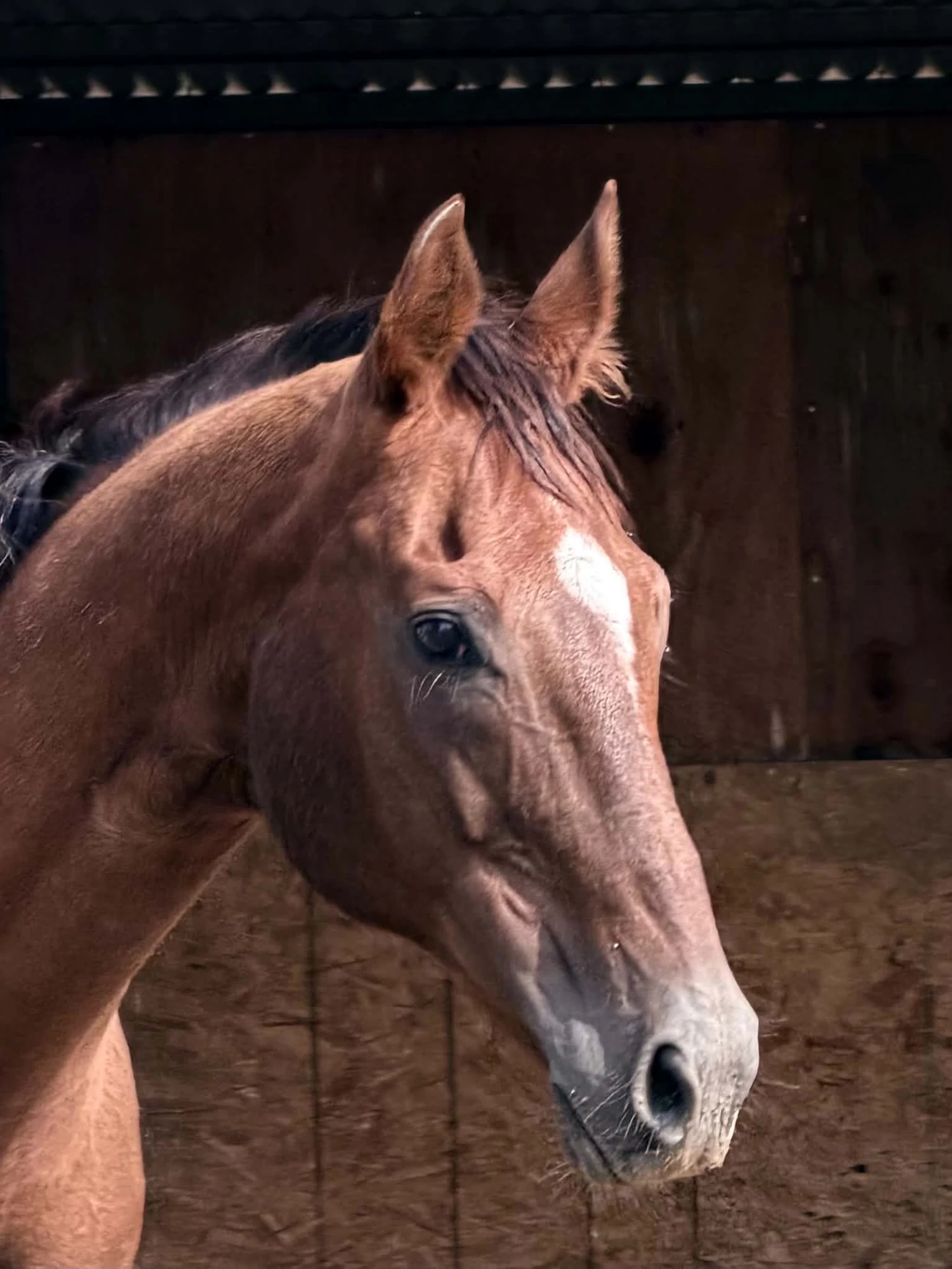
Somewhere in that faint, almost holy light before dawn, when the dusky blue of night begins to surrender to the first gold of morning, a baby is born. A tiny Thoroughbred foal, still wet from the journey into this world, folded into the straw beside the mare who carried it there.
She lies close, her body curved around this brand new life, her neck bent back as she licks and nudges and softly nickers to the baby beside her. There is something ancient in that moment, something instinctive and tender and almost impossible to put into words. She is not thinking about pedigrees or purses or sales prices or winner’s circles. She only knows this little life is hers to protect. And while the rest of the world will soon begin dreaming about what that baby might become, the mare asks for nothing. She will give her body to nourish it, her strength to protect it, her patience to teach it and her presence to help it find its feet. She will stand beside the dream before the dream even knows how to stand on its own.
And then somehow, we become very good at remembering the dream and very bad at remembering the mare.
Maybe that is why her name stopped me when I first saw it. Debtbreaker. Think about that name for a minute. She never raced. Not one start, not one dollar earned on the track. Whatever hope was wrapped up in that name never played out beneath her own feet. Was she supposed to be the one? The one who ran fast enough, won enough, brought home enough money to finally break the cycle of debt? We may never know. Somewhere along the way, though, the hope shifted from what Debtbreaker might do to what Debtbreaker might produce. Maybe this next baby would be the one. Maybe this foal would carry enough speed, enough heart, enough promise to change everything.
Debtbreaker is 21 years old now, a chestnut Thoroughbred mare foaled in California in 2005. Her racing record shows zero starts and zero earnings, but her history as a broodmare tells another story. She has five registered foals that we can see. All five became starters and at least two became winners. Her babies earned more than $52,000 on the racetrack. One of her daughters, Debt Free Abby, sold for $37,000 as a yearling. Another, Anyone Seen Logan, earned more than $29,000 racing.
And here is the part I cannot stop thinking about. Isn’t it amazing how well we can keep track of these horses when they are still inside the Thoroughbred industry? The Jockey Club has a record of Debtbreaker. We know her pedigree. We know the registered Thoroughbred babies she produced, who their sires were and when they were born. Once those babies entered racing, there are records of their starts, wins and earnings. We can follow the pieces of their lives that matter to breeding, registration and racing in incredible detail.
Then a horse leaves that world and the thread can simply disappear.
Debtbreaker stops producing registered Thoroughbred babies. She isn’t racing. Somewhere down the road she changes hands, maybe once, maybe several times, and suddenly there is no mandatory lifetime record following her from owner to owner. We do not have a clean trail telling us where she lived, who had her or how this mare, whose pedigree and babies were so carefully documented, eventually ended up where she did.
That is the part I cannot get past. We have already proven we can track these horses. We do it when the information matters to breeding, registration and racing. What we have not done is require that same thread to stay attached to the horse for the rest of its life.
If we can keep track of what they give the industry, why can’t we keep track of the horse?
I don’t know every hand Debtbreaker passed through between then and now. I don’t know every pasture she stood in or every person who owned her, and I don’t know who ultimately made the decision that put her into the auction pipeline. I am not going to make up the pieces we do not know because the truth is enough.
At 21 years old, after spending years producing the next generation of Thoroughbreds, Debtbreaker ended up sitting in a kill pen. Because the border to Mexico had been closed, she sat there for more than two months.
I think people sometimes hear that the border is closed and assume that means the horses are safe. It doesn’t. Horses continue entering the pipeline, and when they cannot move back out, they sit. Facilities become crowded. Horses that have already been hauled through auctions and sale barns, stressed and exposed to who knows what along the way, now stand surrounded by other stressed horses coming from other places. Sickness moves through them. Horses get hurt. They colic. Some become critically ill and some die right there. A horse does not have to cross the Mexican border or ultimately be slaughtered for human consumption to suffer terribly inside the slaughter pipeline.
This is where I get frustrated with so much of the conversation around slaughter because we spend an incredible amount of time fighting about the very end of the problem. We argue about kill pens, kill buyers, whether a particular horse was really going to ship, whether rescues should buy from these places and who is making money from whom. Meanwhile, another horse enters the pipeline, and then another one behind that one.
Macho Rocket made hundreds of thousands of people ask that question because his story was almost impossible to believe. An $825,000 Thoroughbred, one start, one win, later used for breeding, and eventually a kill pen. His history made people stop. That enormous original price tag made people wonder how a horse once considered that valuable could possibly end up there.
But I never want anyone to walk away from Macho’s story believing his life was worth more because somebody once paid $825,000 for him. That number made his story shocking. It did not make his life more valuable.
Not every horse is Macho Rocket, but every one of their lives matters.
Some Thoroughbreds make millions. Some never make a dime. Some give us their speed. Some give us their babies. Some do both. Some give their bodies to racing until those bodies cannot do it anymore, while others spend years carrying and raising the next generation. Some break down. Some quite literally give their lives doing what human beings bred and trained them to do. There is an enormous economy built around these horses, and people make money because of what these animals give.
Debtbreaker never earned a dollar on a racetrack, but that does not mean she did not contribute to the industry. Her contribution happened quietly, in foaling stalls and pastures, standing beside babies carrying somebody else’s hopes for tomorrow.
So I have a really hard time accepting that once these horses stop producing something of value to us, keeping track of them suddenly becomes too difficult.
This is why I keep coming back to lifetime tracking. Every Thoroughbred should have an identity that follows that horse from birth until death, and every transfer of ownership should follow it too. Racing to breeding. Breeding to a second career. One owner to another. One state to another. Keep the thread attached to the horse. When that horse dies, close the record.
I already know what some people are going to say because I have heard it. The racing industry cannot possibly be responsible for every horse forever. Horses change hands too many times. You cannot track all of them.
I am not asking the breeder of a 21-year-old mare to personally feed her until the day she dies. I am asking us to know where she went.
We already have systems capable of recording enormous amounts of information about these horses while they are participating in registered breeding and racing. Other countries have shown that stronger lifetime identification systems for horses are possible. We are capable of doing better. The question is whether we are willing to keep caring about the horse after the horse stops producing money.
And yes, accountability changes things. If every transfer follows the horse, it becomes harder to quietly move one down the road and never ask another question. If someone knowingly sends a Thoroughbred directly into the slaughter pipeline, that choice does not simply disappear. If horses repeatedly vanish after going through the same hands, there is a trail that lets somebody see the pattern and start asking questions. If we are serious about keeping Thoroughbreds out of the slaughter pipeline, then there also have to be meaningful consequences when people deliberately work around the system.
Maybe that makes some people uncomfortable. Looking at how carefully Debtbreaker and her babies were documented and then realizing we cannot tell you exactly how their mother ended up in a kill pen makes me pretty damn uncomfortable too.
Tracking is only part of it. We also have to talk about money. We are talking about a multibillion-dollar industry, and there has to be a better way for some of the money generated throughout this system to follow these horses into a legitimate safety net. Breeding, registrations, sales, transfers, purses—money moves through this industry in all kinds of places. Surely we can find ways for a small piece of it to support horses after their earning or producing years are over instead of waiting until one is already standing in danger and asking rescues, aftercare organizations and strangers on Facebook to come up with enough money to save them.
I don’t have every answer. I don’t think any one person does. But I refuse to believe an industry sophisticated enough to breed, register, sell, race and document thousands upon thousands of Thoroughbreds cannot figure out how to build a stronger system around the lives of those same horses.
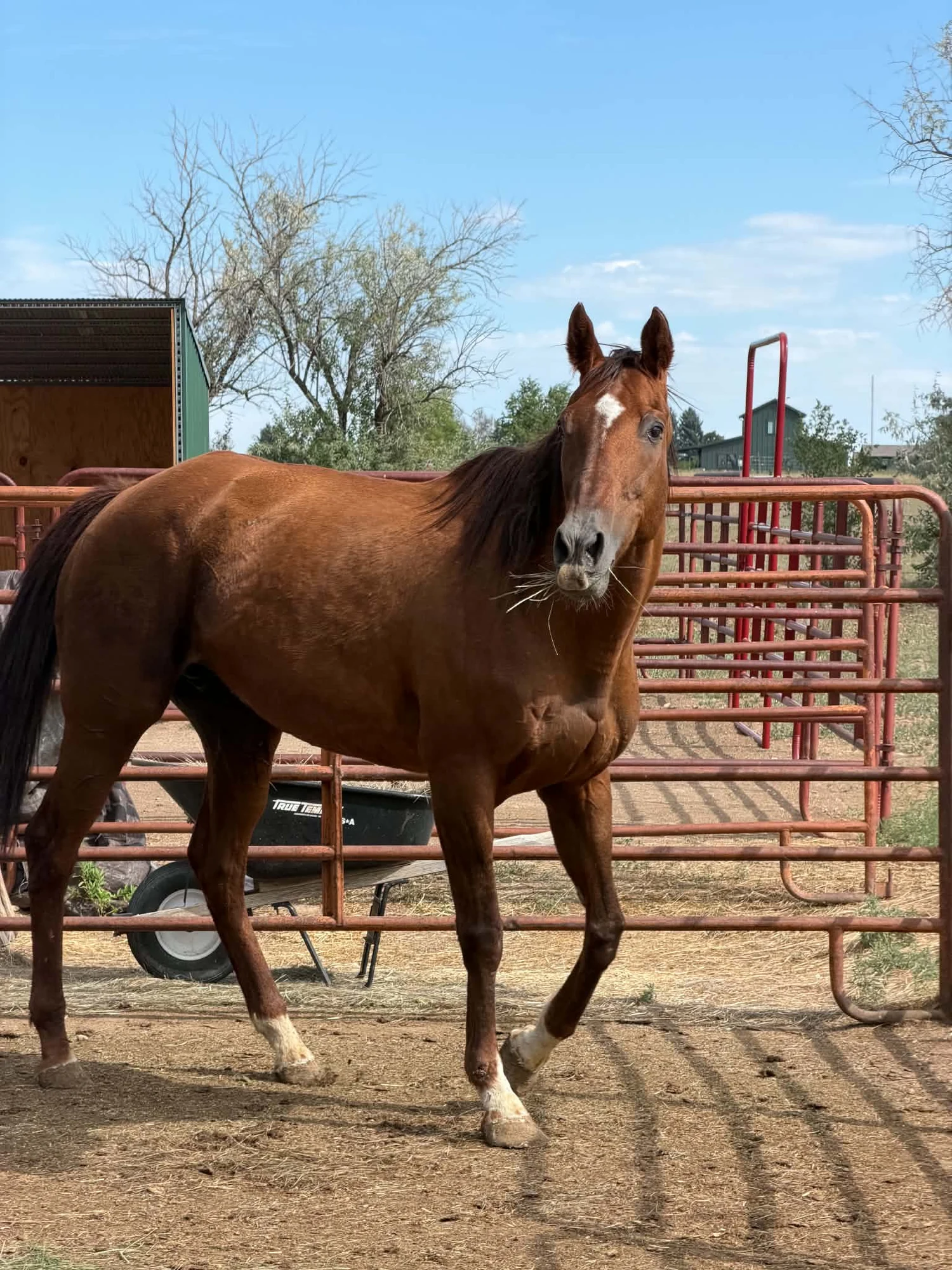
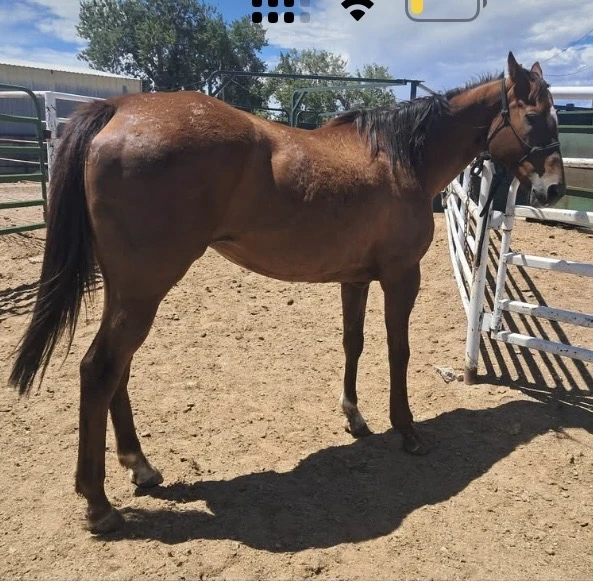
Thankfully, somebody saw Debtbreaker before it was too late.
The Race Fund stepped in and helped get her out. She has now landed safely in quarantine, away from the pen, where she can begin coming down from everything she has been through. Once she is healthy, cleared to travel and ready, she will come home to Journey with Equus through our approved foster program. There she will have the time and space to decompress, receive the care she needs, be loved and simply be a horse while we get to know who she is today. And when she is ready, she gets to show us what the next chapter of her journey is supposed to look like.
Maybe after spending so much of her life being somebody’s mama, that next chapter does not need to be complicated. Maybe it is good food, friends, sunshine, safety and finally getting to simply be Debtbreaker.
And that brings me back to that mare in the straw, because somewhere 21 years ago, in that same soft morning light, Debtbreaker was the baby. She was the one curled beside her mother. She was somebody’s hope for tomorrow, carrying a name that sounds like somebody believed this little horse might just be the one to change everything. Then she grew up and spent years carrying somebody else’s hopes for tomorrow inside her own body.
Maybe that is what I want us to remember when the grandstands are empty and the winner’s circle belongs to somebody new. Behind so many of the horses whose names we remember was another horse whose name most of us never knew. A mare who carried the dream before it had a name, brought it into this world and stood beside it until it could stand on its own.
Debtbreaker is safe now, thank God. But I do not want the victory to be that we happened to find her in time. I do not want rescue to always mean standing at the very end of a broken system trying desperately to catch the ones who fall out.
there was her.
And she should matter long after the cheering stops.