
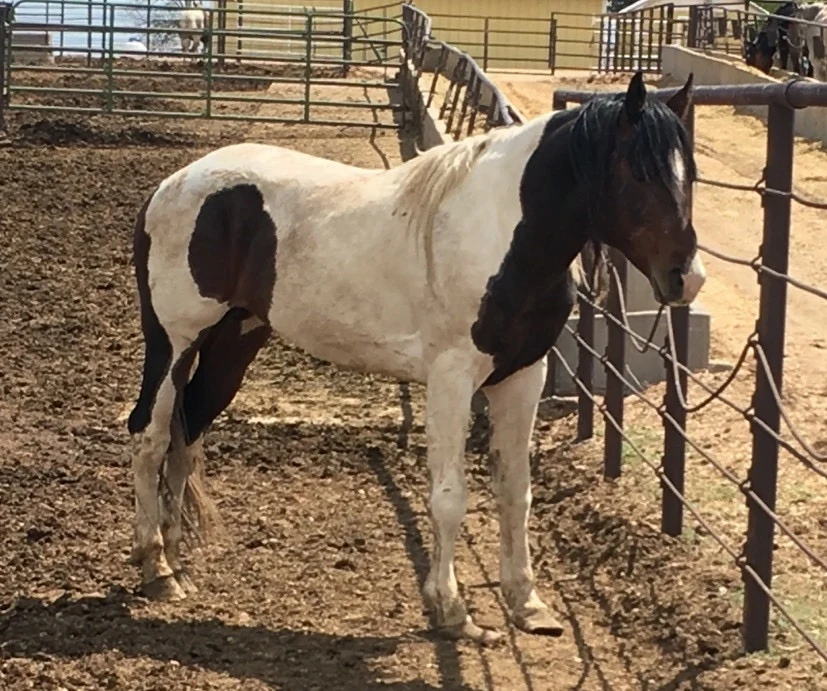
This conversation has made its way around the horse world again, and now onto the Badly Behaving Bettys page, so I decided it was time to put my thoughts in one place. This is an argument I have heard for years, and I think we keep starting the conversation in the wrong place.
First, this is not about attacking the trainer whose comments started the discussion. I don’t know her personally, and I have actually seen her raise other issues within the horse industry that I think are worth talking about. We can disagree on something this important without deciding the person on the other side is the enemy. What I want to challenge is the thought process behind an argument I hear over and over again: horses are already being shipped to Canada and Mexico for slaughter, so wouldn’t bringing regulated horse slaughter back to the United States actually be better for the horses because they wouldn’t have to travel as far?
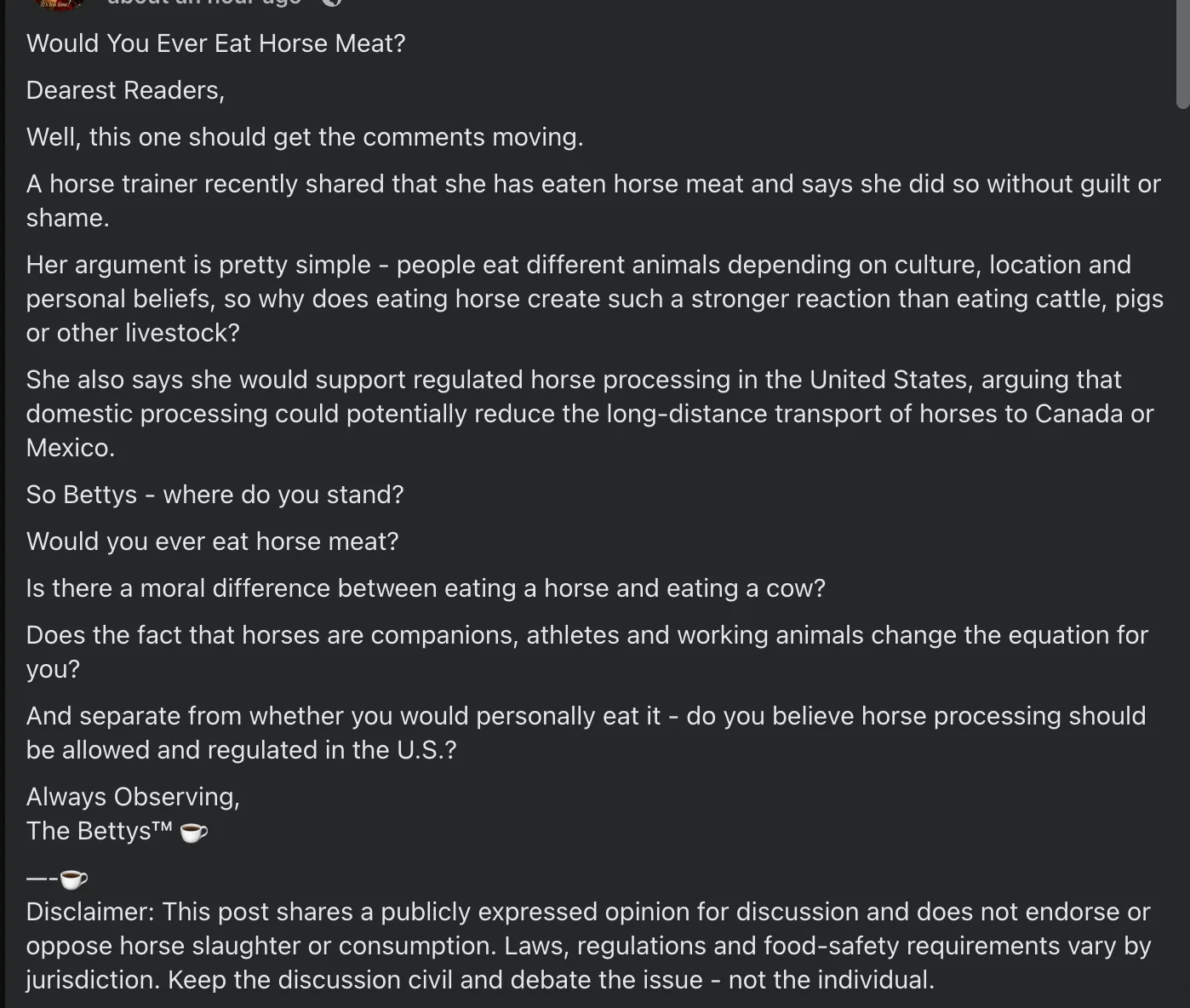
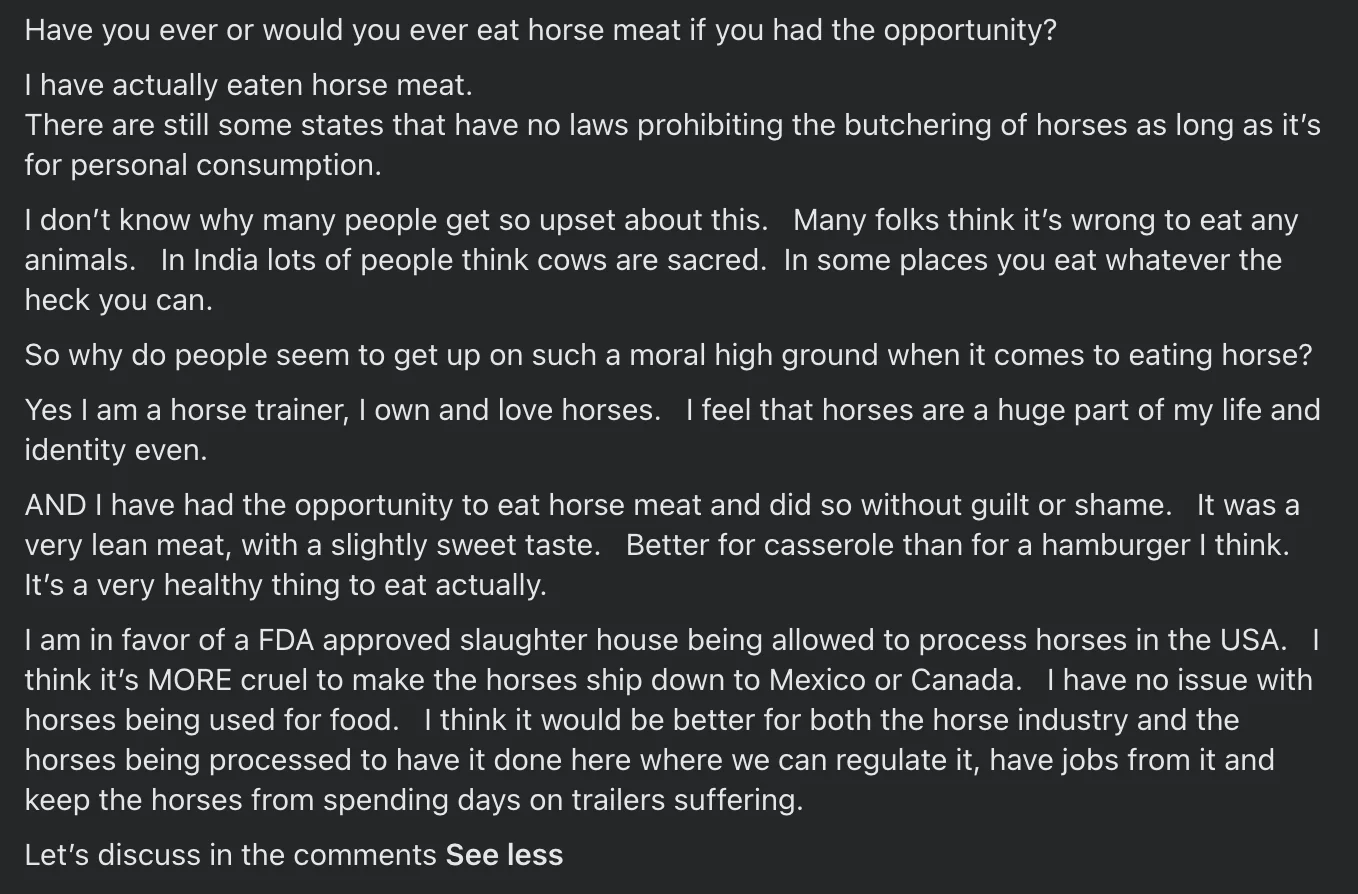
These are the posts that brought the argument back into the conversation. They are included for context. This article challenges the idea — not the individual behind it.
No. I don’t believe it would. And I think that argument begins the conversation way too late.
Whether I would personally eat horse meat is honestly beside the point for me. Different cultures eat different animals, and people can debate that morality all day long. What matters to me is what those of us actually working in rescue and sanctuary see week after week. The real question isn’t what happens at somebody’s dinner table. The real question is why the horse is standing in the slaughter pipeline in the first place.
The suffering does not begin when a horse is crammed onto an overcrowded slaughter-bound truck headed for Canada or Mexico. By that point, many of these horses have already spent days, weeks or longer moving through a system that was never designed with their welfare as the priority. It can begin in the first auction pen, then another sale, then a trader, then another holding pen, another buyer and eventually a kill pen. Horses are mixed with unfamiliar animals, hauled repeatedly, exposed to disease, stressed, injured, dehydrated and sometimes dealing with respiratory illness or colic. Horses who were already compromised can deteriorate quickly. Some never even make it to that final slaughter-bound truck.
Moving the slaughterhouse closer does not eliminate any of that. It does not eliminate the low-end auction. It does not eliminate the traders. It does not eliminate the repeated hauling, the holding pens, the kill buyers or the horses changing hands over and over with little continuity of care. It simply changes where the horse ultimately dies. That is not the same thing as solving a welfare problem.
Approximately 25,000 American horses were shipped across our borders for slaughter in 2025. Twenty-five thousand. And those are the ones reflected in the available slaughter-export numbers. That number should be disturbing enough all by itself, but anyone who has ever tried to follow a horse through low-end auctions, private sales, traders and repeated ownership changes knows how quickly the trail can become difficult or impossible to follow. That isn’t a reason to throw our hands up and say we can never track them. It is exactly why we need a better system. (ASPCA)
Look at what is happening today. People are already willing to put horses into this pipeline even knowing the final destination may be Canada or Mexico. They are doing it despite the longer haul. They are doing it despite years of rescue organizations showing the public what can happen to horses along the way. So forgive me if I do not believe making the disposal of unwanted horses easier, closer and more convenient is somehow going to inspire more responsible horse ownership.
I worry it does exactly the opposite.
If there is always an easy outlet for the horse who didn’t win, didn’t breed the foal somebody wanted, didn’t become that one-in-a-million prospect, got hurt, got old, became expensive or simply became inconvenient, where is the pressure to change what happens upstream? How does easier disposal encourage more thoughtful breeding, better placement or greater responsibility? I am not saying every breeder, trainer or owner operates this way. Of course they don’t. There are incredible people in this industry who follow their horses, take them back, spend the money and genuinely care where they are years later. But good people existing inside a system does not mean the system has enough safeguards.
We have also already lived in a country with domestic horse slaughter. In 2006, the last full year of domestic slaughter operations, 104,899 horses were slaughtered in U.S. plants. Another 32,789 U.S. horses were sent to Canada and Mexico for slaughter that same year. That is 137,688 horses in one year. Domestic slaughter was not some tiny emergency safety valve being used for a handful of horses who had nowhere else to go, and having slaughter plants here did not stop American horses from being exported for slaughter elsewhere. (Government Accountability Office)
That history does not prove that every irresponsible breeding decision happened because slaughter plants existed. That would be too simplistic. But it absolutely destroys the idea that domestic slaughter somehow created a humane, limited safety net. It created enormous capacity to dispose of horses. I don’t want to make disposal easier. I want to make responsible ownership harder to walk away from.
And most Americans do not want horse slaughter returned to this country either. A 2022 national poll commissioned by the ASPCA found that 83% of Americans opposed slaughtering U.S. horses for human consumption, with opposition extending across political affiliation and rural and urban communities. We are not a country overwhelmingly asking for horse slaughter plants. (ASPCA)
So let’s talk about what would actually make a difference before the horse ever gets close to a slaughter-bound truck.
We need to talk about breeding responsibility and what happens to all the horses who don’t become the exceptional one somebody was trying to produce. We need to talk about the racehorse who isn’t fast enough, the broodmare who no longer produces what someone wants, the performance horse who gets injured and the senior horse who becomes more expensive than convenient. We need to talk about what happens when economic value disappears even though the horse may still have years of life left.
And we need to talk about how horses are sold, because good intentions are not a safety net.
If you genuinely care where your horse ends up, where and how you sell that horse matters. Selling a horse cheaply through a low-end local auction and hoping a wonderful person happens to buy them is not a plan. We need meaningful contracts, right-of-first-refusal and return provisions that actually mean something, microchips tied to useful lifetime records, ownership transfers that follow the horse, home checks when appropriate and actual follow-up. We need real aftercare, and we need the industries that breed, race, show, sell and profit from horses contributing meaningful money toward that safety net.
And please, enough with the same old argument that we could never track all these horses.
Come on.
We track pedigrees generations deep. We track registrations. We track race starts, earnings, breeding records, sale prices and bloodlines with incredible precision. When there is money attached to a horse, somehow we have figured out how to keep very good records. We can figure out how to care where that same horse goes when the money stops.
Then there is another part of this pipeline that absolutely breaks my heart and, quite frankly, makes me angry: the senior horses, seriously injured horses, chronically lame horses and horses whose quality of life is already failing that still get put into this system.
Please, people, euthanize your horse.
I know how hard those words are. I have held horses I loved while they left this world. We choose to cremate ours because that matters deeply to us. There is nothing easy about saying goodbye to an animal you love. But there are things worse than death.
An elderly horse who has trusted you for twenty years does not deserve to be hauled to an auction because somebody might give you $300 or $500 for them. A horse who is already hurting does not deserve to stand frightened in an unfamiliar pen, get loaded again, change hands, get hauled again, become sick and eventually make their way toward slaughter because somebody could not bring themselves to make the final responsible decision.
The American Association of Equine Practitioners recognizes humane euthanasia as a responsible option when a horse faces continuous or unmanageable pain or circumstances incompatible with an acceptable quality of life. Sometimes a peaceful ending is the final responsibility we owe them. (AAEP)
And yes, I already know what somebody will say: “Do you know how much it costs to euthanize a horse and take care of their remains?”
Yes. I do.
I also understand that genuine financial hardship exists, and I would love to see far more community assistance available for owners who truly cannot afford humane end-of-life care. That would be an equine-welfare initiative worth investing in. But feed costs money. Farrier care costs money. Veterinary care costs money. Emergencies cost money. End-of-life care costs money. That is part of the responsibility we accept when we choose to own these animals.
What is even harder for me to understand is when financial hardship is clearly not the issue. We see horses leave people, programs and industries with substantial resources, and somehow when the horse becomes old, injured, unprofitable or inconvenient, getting a few hundred dollars out of them becomes preferable to spending money to make sure that horse has a safe landing or a peaceful goodbye.
That is where I really struggle.
If a horse raced for you, competed for you, bred for you, produced babies for you, made money for you, helped build your program or simply trusted you and gave you years of their life, you owe that horse something at the end. A safe landing or a humane goodbye. Not one last check for $500 and a trip through an auction.
And then we need to talk honestly about what happens at slaughter, because I keep hearing the word “regulated” used as though regulation automatically means humane.
I want to be factual here. The AAEP does recognize penetrating captive bolt as an acceptable method of equine euthanasia when it is performed by properly trained personnel using an extended bolt designed for euthanasia, with prior sedation considered when possible. That is important, because a controlled euthanasia performed for the welfare of one individual horse is very different from moving frightened horses through a commercial slaughter line. (AAEP)
The research from actual slaughter facilities should make every horse person stop and think.
A recent study followed 100 horses stunned with penetrating captive bolt at a commercial slaughterhouse in Mexico. Twenty-eight percent showed behavioral signs of ineffective stunning. Twenty-five percent required more than one shot, with one horse receiving as many as ten. Sixteen percent of shots missed the brain entirely, and 44% of the horses showed no damage to critical brain structures associated with consciousness. The researchers themselves described substantial welfare concerns with the effectiveness of the slaughterhouse setup and operation. (PubMed Central (PMC))
Another study involving horses under commercial slaughter conditions found rhythmic breathing and other signs of possible consciousness after the first shot in a significant number of animals, with researchers pointing to equipment and cartridge specifications as part of the problem. This is exactly why it is misleading to take an accepted euthanasia method under controlled conditions and assume that automatically makes commercial slaughter humane. (PubMed Central (PMC))
And this is where the reality gets incredibly uncomfortable. The World Organisation for Animal Health specifically recognizes ineffective stunning and recovery of consciousness as welfare risks at slaughter. Its standards warn that when stunning is absent or ineffective, animals can be shackled, bled or further processed while still conscious or capable of regaining consciousness. That is why those same standards require monitoring for consciousness before and during bleeding and immediate backup stunning when the first attempt fails. This is not somebody trying to shock people on social media. These are the welfare risks international slaughter standards themselves are written to prevent. (WOAH)
So no, I am not comfortable being told that all we need to do is move slaughter back onto American soil, regulate it and call it humane. A peaceful, planned euthanasia performed because it is in the best interest of an individual horse is not the same thing as commercial slaughter. They should not be spoken about as though they are interchangeable.
And even if someone could guarantee a perfect stun every single time, which the research certainly does not show, we would still be ignoring the bigger point: none of that fixes what happened before the horse arrived at the plant. It does not fix the auction. It does not eliminate the trader. It does not stop repeated hauling. It does not address overbreeding. It does not create lifetime tracking. It does not create contracts, aftercare or accountability. It simply gives the existing pipeline a closer endpoint.
Meanwhile, small grassroots rescues and sanctuaries are standing in the gap.
We pay to get the horse safe. We pay transport. We pay quarantine. We call the veterinarian. We treat pneumonia and the illnesses that so often show up after these horses have been through the pipeline. We rehabilitate injuries. We buy hay. We build fences and shelters. We search for foster homes. Sometimes we make a promise to provide sanctuary for the rest of that horse’s life.
Then we fundraise again.
We do this while enormous amounts of money move through the larger horse industry, and for so many good organizations sustainability always seems to sit just out of reach. That should bother every single person who says they love horses.
The answer cannot be building enough rescues to catch every horse after the system fails them. There will never be enough stalls, foster homes, sanctuaries or donor dollars to do that.
The answer has to be failing fewer horses in the first place.
Better breeding decisions. Better placement. Better tracking. Better contracts. Real aftercare. Responsible end-of-life choices. More accountability and meaningful financial investment from the industries that benefit from these horses while they are profitable.
That is what horse welfare looks like to me.
So when somebody asks whether I would ever eat horse meat, I understand why it makes a provocative headline and gets people talking. But it is not the question I think matters most.
The question I want answered is this: if we truly love horses, why are we still debating how to make disposing of them easier instead of doing the harder work required to stop so many of them from becoming disposable in the first place?
I don’t want a shorter road to slaughter.
I want fewer horses ever put on that road.
We should be shutting off the faucet, not building a bigger drain.